The Name No One Knows
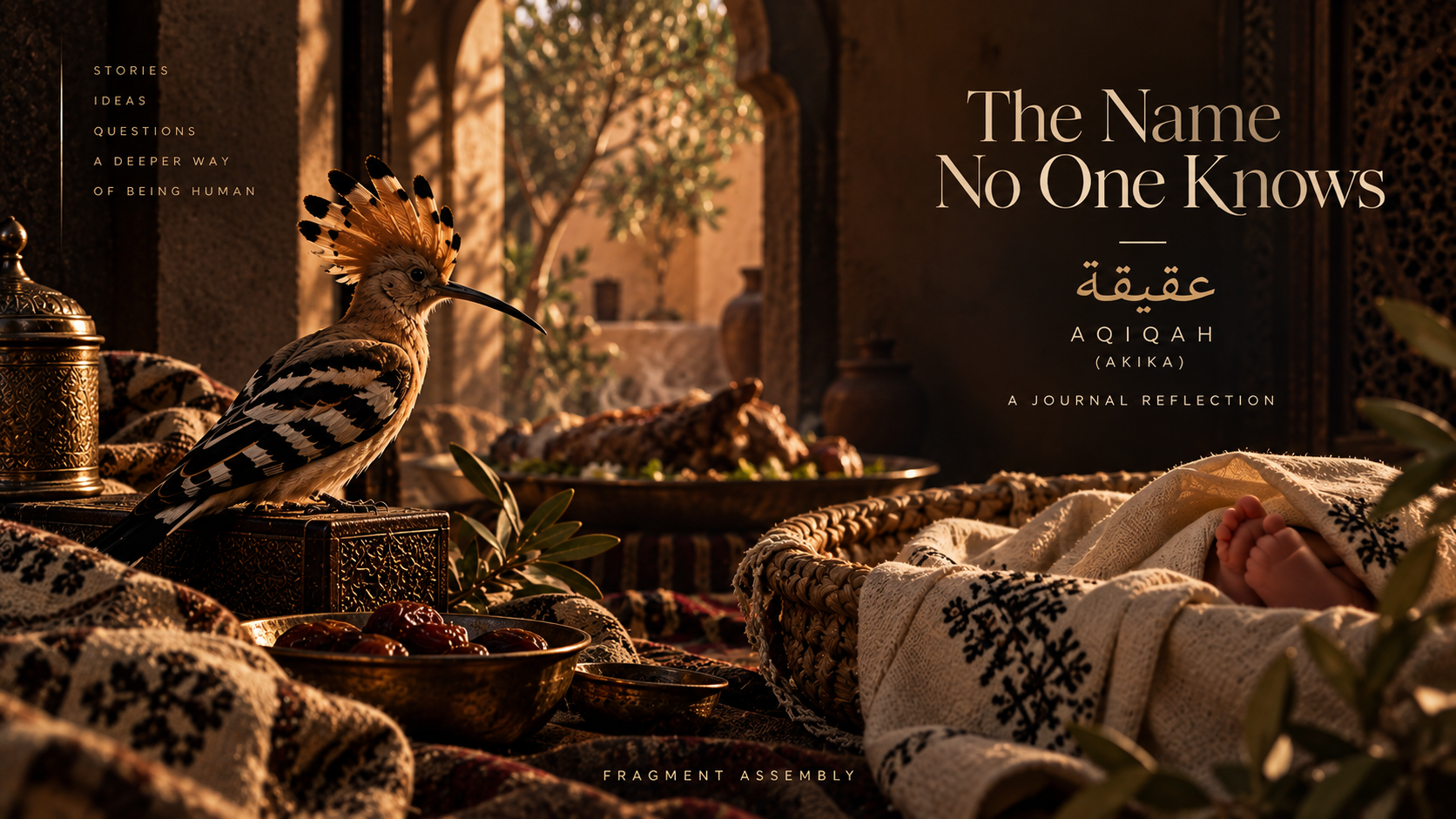
By noon, the house had become too small for the number of people inside it. Women moved between the kitchen and the courtyard carrying enormous dishes; children raided the sweets and vanished before anyone could catch them; chairs migrated from neighboring houses; greetings came through the door faster than they could be answered. The smell of the feast had reached the street, the older women had already begun their serious investigation into whose eyes and nose the baby had inherited, and somewhere in the middle of all this magnificent disorder, the person responsible for the entire gathering was asleep.
This was the ʿaqīqa.
There is no exact Western equivalent. A baby shower comes closest, except the ʿaqīqa happens after the child is born. Traditionally, a sheep, lamb, or another animal is offered for the occasion, food is prepared and shared, and relatives and neighbors gather to celebrate the child’s arrival into the family and community.
In some families, something else happened during that ceremony. The baby already had an official name, the one registered on the birth certificate and destined for school records, passports, diplomas, signatures and every bureaucratic document life would eventually demand. But at the ʿaqīqa, the child could also be given a spiritual name, sometimes regarded within the tradition as the real name, known only to a small circle of family.
The secrecy came from an old belief about protection. If someone attempted sorcery against a person, they would use the name by which that person was publicly known. But they would be working with the wrong name. The real name had never been given to them.
I don’t share the belief in sorcery, but I have always been fascinated by the intelligence hidden inside the custom: the world could know your name and still not know what you were called at the beginning.
Because the public name does not remain merely a name. It goes out into the world and gathers a biography. It is called across classrooms, printed on documents, mispronounced in foreign countries, whispered by lovers, signed beneath promises, attached to work, marriages, departures, failures and achievements. A person can spend an entire life answering to a name that has become crowded with other people’s meanings—and eventually with her own.
By the time we are old enough to seriously ask Who am I?, we have accumulated an impressive amount of evidence. We reach backward for what happened to us, what we survived, what we built, what we lost, what we chose and what we still regret choosing. Memory supplies the witnesses. The story becomes so detailed that it begins to sound final.
Until life removes something we thought the story required.
A profession ends after decades. A marriage becomes history. Children grow into lives that no longer revolve around ours. A conviction we once defended fiercely can no longer survive what we now know. Something that wounded us for years finally loses its power, and even its absence is disorienting. The biography changes while the person whose name appears at the top of the page remains.
Maybe this is why certain moments of change feel so much like losing ourselves. We have confused the disappearance of an explanation with the disappearance of the person it explained.
And this is where that old ʿaqīqa custom becomes far more interesting to me than the superstition that preserved it.
The spiritual name was there before the evidence.
Before reputation had formed around the child. Before achievement could decorate her and failure could embarrass her. Before love could tell her who she was, before grief could revise it, before the world had collected enough material to construct a convincing biography and hand it back to her as identity.
The name was given near the beginning.
And that is what turns the entire question around.
We spend so much of life asking what we are becoming that we rarely consider what all this becoming has accumulated around.
Whenever I follow that thought far enough, I arrive at Dhu al-Nun al-Misri.
He was asked:
“What is the end of the mystic?”
He replied:
“When he is as he was before he was.”
— The Hoopoe, Fragment Assembly