The Fire That Became a God -The Barbarian — 1
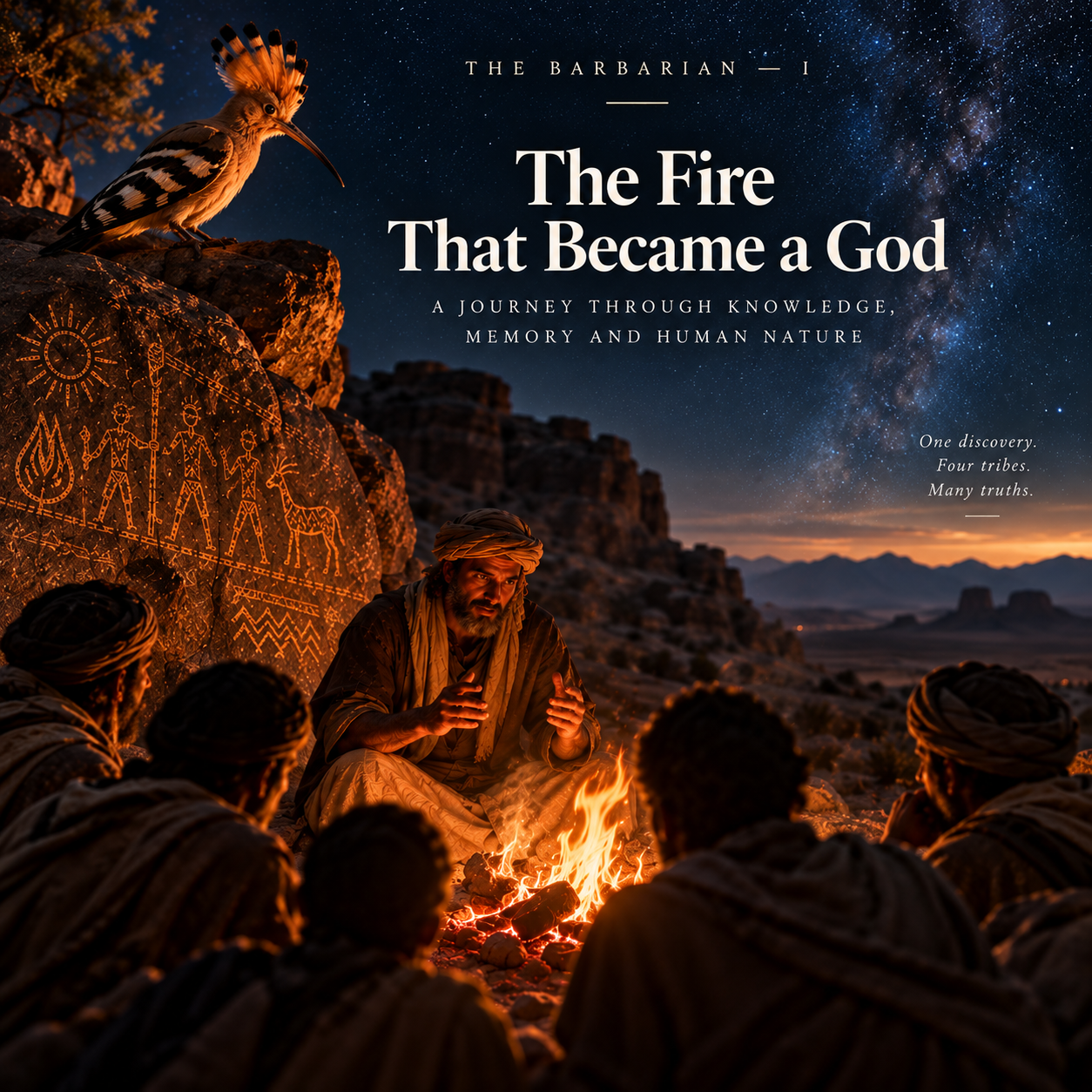
Nour discovered fire.
Before him, his people knew what fire was. They had seen what lightning could do to a tree and what the summer heat could leave behind when the earth became dry enough to burn. Fire existed, but it belonged to nature. It appeared when it wished and disappeared when it wished, and human beings could benefit from it only when chance placed it within their reach.
Nour discovered something different. He learned how to make it.
The discovery changed ordinary life in ways that must have seemed almost impossible at first. Food could be cooked. Cold nights could be made bearable. Darkness could be pushed farther from the places where people gathered. Materials could be transformed into things that had not existed before.
But the most important thing Nour did was not discovering fire.
He taught other people how to make it.
There was no reason for the knowledge to die with the man who had discovered it. He showed his people what he knew until they could produce the flame without him, and eventually the knowledge traveled beyond his tribe.
Then Nour died.
The fire survived him.
Years later, a wise man and his disciples began traveling through the lands where Nour's knowledge had once been carried. They expected to find people making fire.
Instead, they discovered what time had done to the teaching.
In the first tribe, the knowledge had survived perfectly well, but only the priests possessed it. Somewhere between Nour's discovery and the present generation, the method had become a secret. The priests produced fire before the people and allowed mystery to gather around an act that Nour had once taught openly.
The flame gave them authority.
One of the disciples watched this and offered to teach the people themselves. He told them that the ability was not supernatural, nor did it belong exclusively to the men standing before them. Anyone could learn it.
The priests understood immediately what would happen if he succeeded.
A person who can teach people to make their own fire is very dangerous to someone whose authority depends upon being the only one who can produce it.
The disciple was accused of insulting what was sacred and attempting to interfere with the Divine will. He was removed before the people could learn what he had come to show them.
The travelers continued.
In the second tribe, the priests were gone and nobody claimed supernatural powers. Instead, the people had carefully preserved the instruments once used to make fire.
They protected them. They displayed them. They passed them from one generation to another until the objects themselves became sacred.
The problem was that nobody remembered how to use them.
When another disciple explained that these were simply instruments, that their ancestors had used them for a purpose and that he could teach them the forgotten method, the people were offended.
He did not understand their traditions, they told him. He did not understand their rituals or their relationship with the sacred.
The objects remained exactly where they were.
The travelers moved on.
By the time they reached the third tribe, something even more extraordinary had happened.
These people remembered Nour.
They remembered him so well that they had forgotten what he wanted them to remember.
Stories had accumulated around his name. Generations had repeated them, embellished them and protected them. The man who had taught people how to make fire had slowly become larger than the knowledge he had carried, until Nour was no longer remembered simply as the fire-maker.
They worshipped him.
His image stood before people who could no longer make the fire he had spent his life teaching others to produce.
One of the disciples tried to tell them who Nour had been.
The figure they worshipped represented a man who had discovered a capacity and then taught it freely. He had never asked anyone to kneel before him. If they truly wanted what Nour had brought into the world, the disciple said, he could teach them exactly what Nour had taught.
The answer came from one of Nour's worshippers.
Perhaps what the stranger said was true. But the real secret, he insisted, could be penetrated only by a few. How could an outsider, a man who did not even speak as they spoke or live as they lived, presume to understand Nour better than the people who had honored him for generations?
The disciple was welcome to remain among them.
But the subject was closed.
The travelers continued through the desert until they reached a fourth tribe.
Here, nobody worshipped Nour.
Nobody worshipped the instruments.
Nobody guarded the secret.
These people knew the old story about a man who had discovered how to make fire, but they considered it exactly that: an old story.
A legend.
The fourth disciple told them that the story was true and that he knew the method himself. If they allowed him, he would show them.
Some were curious.
Others laughed.
Their leader had already decided what kind of man stood before him.
Legends were not true, he said. The stranger was merely trying to fool them so that he could make a place for himself among their people.
And so the travelers left again.
Much farther into the desert, they eventually reached another tribe.
There was fire everywhere.
People cooked with it, worked with it and warmed themselves beside it. Children grew up watching adults make it and eventually learned to make it themselves. Nour's discovery had become so ordinary that nobody needed to build a mystery around it.
When the wise man and his disciples arrived, the people did not ask them to prove that fire existed.
They asked them something else.
What else do you know?
— The Hoopoe, Fragment Assembly